The Arab and Hungarian lexicons have become the largest ever built without any artificial trick,
both over 5 million words, and Greenlandic is waxing.
September 2026, 96 languages (incl. varieties)
English
(lexicon size between 524,200 and 525,400 plus, selection
October 2026)
The American English (1), British English (2), Canadian English (3), South-African English (4),
Australian/New-Zealand English (5) versions include a set of collocations and
automatic respelling functions between American English,
Canadian English, and British English orthographical varieties, e.g.,
• (to UK) counseling -> counselling or
• (to US) counselling -> counseling;
• (UK & US) Mao Tse-tung -> Mao Zedong;
• (UK) 1400 AD -> AD1400 (anno Domini,
see the Style Guides of the New York Times and the Economist).
Be careful with expressions as Thanks God its Friday!. Without an apostrophe it looks a bit strange.
Therefore, a set of multiple word corrections is included, e.g.,
• thank God its Friday -> thank God it's Friday,
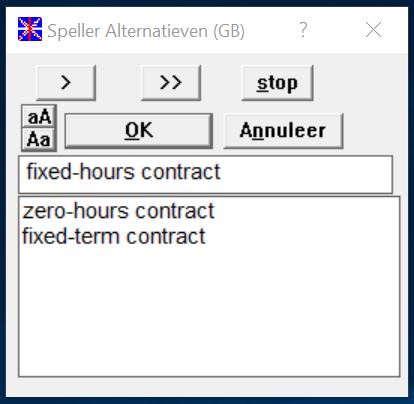
or with multiple alternatives of contaminations (blendings, see the fixed-hours image shown here),
• redo it over -> 1) redo it, 2) do it over, etc.
• tooth and tong -> 1) tooth and nail, 2) hammer and tongs, etc.
Lexicons agree with the leading unabridged dictionaries.
The supplied idiom includes an extensive medical, chemical, social and geographical lexicon.
Finally the idiom includes an extensive orthographical variety of "how-to-build" compounds.
visit download page | Continue ...
French/Canadian French
(lexicon size over 669,000, idiome nouveau, selection August 2026)
Includes the most extensive geographical lexicon. Two lexicons are
available, one according to the spelling of the most recent published "Le Nouveau Petit Robert (2025)" & "Le Robert illustré & Internet (2012)", "Le Larousse (2008)",
and another lexicon according to the most recent Rectifications de
l’orthographe of the Conseil supérieur de la langue française first
published 6 December 1990/1998 (see also http://www.orthographe-recommandee.info) and has become more and more accepted
at present time.
La nouvelle orthographe du français n'est pas imposée, mais elle est officiellement recommandée.
Les modifications, modérées, touchent environ deux-mille mots.
Examples :
• un compte-goutte, des compte-gouttes ; • un après-midi, des après-midis; cout ; • entrainer, nous entrainons ; • paraitre, il parait; j'amoncèle, amoncèlement, tu époussèteras
and most important: Les rectifications de l'orthographe ont été approuvées initialement par :
• Le Conseil supérieur de la langue française (Paris); • L'Académie française (France).
The current version of "La nouvelle orthographe du français" has been optimized and is ready for automatic correction(s).
Both French and Canadian French versions include extensive (automatic) re-spelling tools between previous and new spelling forms, and common mistakes.
visit download page |
view a French Punctuation example (PDF) |
Continue ...
German
(lexicon size 1,346,000, selection August 2026)
The German orthography has been updated with the acceptance of the uppercase Eszett. Previous versions will be kept in the meantime.
The German spelling is distributed in four versions, “alt (pre 1996), new 1996 (the very first reform), new current orthography (2017-2025), and the dpa version (2017-2025)”.
These versions include automatic respelling from old to new spelling forms (e.g., Prozeß → Prozess) and of “feste grammatische und lexikale Wendungen”.
Using the old orthography or “alte Rechtschreibung”
enables you to purify your texts, a full re-spelling system from new to old will surprise you (e.g., Prozess → Prozeß).
A version for the Nachrichtenagenturen (dpa) as proposed by the German-speaking news agencies is also available.
(http://www.die-nachrichtenagenturen.de).
The orthography neue Rechtschreibung is updated according to the Duden 29, August 2024, and the
"Rat für deutsche Rechtschreibung", Grundlagen der Deutschen Rechtschreibung (2024), including the Eszett-Schreibung (ß/ẞ).
The German lexicon includes more than 318.500 expanded catchwords (konjugierte Stichwörter as defined in the Duden),
and includes all German toponyms (Ortsnamen), over 14,000 autocorrections (Umschreibungen) and an extensive medical lexicon.
Moreover, spell checking is strict, we don't approve errors like: Oberklasse-Wagen, Oberstufe-Schüler, Klasse-Bücher.
It has to be: Oberklassenwagen, Oberstufenschüler, Klassenbücher.
visit download page | Continue ...
Swiss German
(lexicon size 1,385,800, Swiss additions to German, selection August 2026)
The Swiss German lexicon includes all Swiss toponyms (Schweizerische Ortsnamen).
There are three versions “alt, neu, dpa/SDA (2025)” see German.
The Swiss German lexicon includes more than 318.500 expanded catchwords (konjugierte Stichwörter as defined in the Duden),
and includes all German toponyms (Ortsnamen).
visit download page | Continue ...
Austrian German
(lexicon size 1,363,000, Austrian additions to German, selection August 2026)
The Austrian lexicon includes all Austrian toponyms (Österreichische Ortsnamen).
There are three versions “alt, neu, dpa (2024)” see German.
The Austriam German lexicon includes more than 318.500 expanded catchwords (konjugierte Stichwörter as defined in the Duden),
and includes all Austrian German toponyms (Ortsnamen).
visit download page | Continue ...
Spanish Peninsular, Argentine, Mexican & Latin American
(lexicon size 991,000 - 998,400, selection October 2026)
The spelling is according to the new orthographical rules presented in the latest (la última edición)
of the Ortografía de la lengua española (2010) and the Diccionario de la lengua española, RAE (2014).
Includes respelling of a set of orthographical changes and common errors, e.g.
exteniente coronel → ex teniente coronel,
ex presidente brasileño → expresidente brasileño,
anti-mafia → antimafia,
Adam y Eva → Adán y Eva,
Edinburgo → Edimburgo.
visit download page | Continue ...
Italian
(lexicon size 998,300, selection May 2026)
The spelling is according Lo Zingarelli 2026.
Includes pronomial forms, and an extensive geographical lexicon (comuni e luoghi italiani), a wide range of medical idiom, and a set of multiple word corrections, e.g.,
le USA -> gli USA, il pneumatico -> lo pneumatico, vicino Roma -> vicino a Roma.
visit download page | Continue ...
Swedish
(lexicon size over 2,202,500 words, selection September 2026)
Includes geographical and proper names, numerical SI unit correction and punctuation correction
(not «blod, svett och trådar», but »blod, svett och tårar»);
(not tilldess, but till dess);
orthography according to Svenska Akademiens ordlista över svenska
språket.
Why even subtitles should be spelled! (sorry SVD, you would have done better): "På Karlskona musteri odlas en variation av äppelsorter."
visit download page | Continue ...
Portuguese
(lexicon size 1,736 million words, selection October 2026)
Iberian and Brazilian Portuguese are very different in terms of use of verb tenses and idiom.
Often Brazilian Portuguese is unacceptable for Iberian Portuguese publications, and
the reverse is a source of misunderstanding too.
Independently of orthography dictionaries need to be different.
Therefore Iberian and Brazilian versions according to the previous and acordo ortográfico, have been compiled.
These versions include respelling either between Iberian Portuguese and Brazilian Portuguese or
between the previous and acordo ortográfico.
O presidente de Portugal, Aníbal Cavaco Silva, promulgou o acordo ortográfico da língua
portuguesa, ratificado no Parlamento do país em maio, informaram hoje à Agência Efe
fontes da Presidência. ....,
O Novo Acordo Ortográfico da Língua Portuguesa está em vigor no Brasil desde o último dia 1º (2009, Grande Dicionário 2010).
Examples: equipolente versus eqüipolente or boleia versus boléia or ação versus acção. visit download page
Dutch
(Nederlands, lexicon size 897,400,
selection August 2026)
The spelling according to the governmental rules (Groene Boekje, Workgroup Spelling, 2005, Taalunie, update Taalunie errata 27-08-2010) and is in
agreement with Van Dale Groot Woordenboek van de Nederlandse Taal (March 2022).
The lexicon's idiom covers national and mondial geographic information, medical, administrative,
social and many other special terms. Over 348,000 words have been classified according to present-day grammar.
A set of over 28,000 collocations and (respelling) autocorrections from the previous to the new orthography is included.
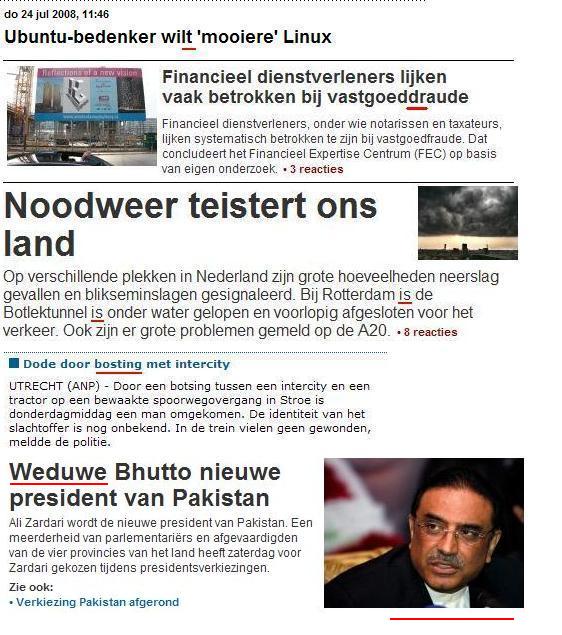
This set includes multiple word alternatives for weird combinations such as "door de regen en de wind" -> 1) "door weer en wind" or 2) "in de regen en de wind",
a linguistic mutilation of "(come) rain and shine".
visit download page | Continue ... |
hall of shame ...
Flemish
(Vlaams, lexicon size 922,000,
selection August 2026)
The spelling according to the governmental rules (Groene Boekje, Workgroup Spelling, 2005, Taalunie, update Taalunie errata 27-05-2008) and
agrees with
Van Dale Groot Woordenboek van de Nederlandse Taal (March 2022.)
The lexicon's idiom covers national and mondial geographic information, medical, administrative,
social and many other special terms.
A set of over 27,000 collocations and (respelling) autocorrections from the previous to the new orthography is included.
This set includes multiple word alternatives for weird combinations such as "kost duur" -> 1) "is duur" or 2) "kost veel",
a linguistic mutilation of "is expensive".
visit download page | Continue ...
Surinam Dutch
(Surinaams-Nederlands, lexicon size 898,200,
selection August 2026)
The Republic of Surinam has entered the Dutch Taalunie (January 2005)
to unify their language
with the Dutch language. The peculiarities of Surinam
Dutch call for a separate lexicon.
The spelling agrees with the governmental rules (Groene Boekje, Workgroup Spelling, 2005, Taalunie).
The lexicon's idiom covers national and mondial geographic information, medical, administrative,
social and many other special terms.
A set of collocations and respelling from old to
new orthography is included. visit download page | Continue ...
Catalan (nova ortografia)
(lexicon size 1,454,100, selection Februari 2023)
The lexicon includes all combinations of pronoms personals.
The spelling agrees with Diccionari ortogràfic i de pronúncia, Enciclopèdia Catalana.
The nova ortografia, not arítmia but arrítmia, not angiospasme but angioespasme,
not dóna'ls-el but dona'ls-el,
agrees with the Institut d'Estudies Catalans (May 2017)
whose spelling reform has been entered with a transition period of five years, so it presently is valid!
The current version removes inverted question marks and inverted exclamation marks, which only apply to the Spanish language domain!
visit download page
Danish
(lexicon size over 1,238,300, selection September 2026)
The spelling agrees with the Contemporary Danish spelling according to
Dansk Retskrivingsordbogen of the Dansk Sprognævn, med ændrede ord- og staveformer; with orthographic changes of 2012.
It includes geographic names (stednavne), present-day idiom, and a set of multiple word corrections (faste udtryk), e.g.,
æblerne lægger i skålen -> æblerne ligger i skålen,
web siterne -> websiterne,
det globale solar plexus -> den globale solar plexus,
en enorm stor panda -> en enormt stor panda, etc.
The latest version includes COVID and corona idiom (including Delta and Omicron subjects), and in addition,
35.500 new words have been added to our Danish corpora.
visit download page
Norwegian, Nynorsk
(lexicon size Bokmål 1,420,100, Nynorsk 619,600,
selection October 2026)
The spelling agrees with the Contemporary Norwegian spelling
according to Tanums Store Rettskrivningsordbok and the Norwegian Språkrådet.
It includes present-day idiom, and a set of multiple word corrections, e.g.,
i Møre -> på Møre (always notify),
på Møre og Romsdal -> i Møre og Romsdal,
setter på en stol -> sitter på en stol,
så ofte syk -> sjelden syk, etc.,
see also "https://sprakradet.no/godt-og-korrekt-sprak/praktisk-sprakbruk/i-eller-pa/".
and 24,128 new words have been added to our Norwegian corpora of the current version 6.2.5.0.
In addition, the Rettskrivningsendringer of 26 sept. 2023 have been applied to our newest Bokmål and Nynorsk ordbok.
visit download page
Sámi
(lexicon size 1,6 million, selection March 2008)
The spelling agrees with the Nord Sámi language as spoken in Finnmark
county in the north of Norway. Sámi is a highly inflected language and words can have numberous word forms.
This feature makes the North Sámi lexicon very lengthy.
visit download page
Finnish
(lexicon size over 5.705 million words,
selection October 2026)
Spelling and templates (taivutustyypit) of the revised modules agree with the Contemporary Finnish, Kielitoimiston sanakirja, 2012.
The lexicon has extensively been tagged with declension and conjugation classifications.
The current version is enriched with new idiom collected during 2024 and 2026.
This is a requirement given the compound nature of the Finnish language.
Corona idiom from newspapers and official sources has been added during 2020 and 2021.
visit download page
Afrikaans
(lexicon size 341,550, selection August 2024)
The lexicon agrees with the spelling rules of the Suid-Afrikaanse
Taalkommissie. It matches to present-day idiom of the South African society,
including a wide variety of neologisms, geographical, business, and social words.
The spell checker includes mechanism to proof neologisms by examination of component parts.
This mechanism doubles the effective size of the lexicon. visit download page |
die taal en die passende tegnologie (PDF)
Latin
(lexicon size 450,000,
selection August, 2007)
The Latin lexicon has been compiled from
classical, medieval, clerical, vulgate, and scientific texts. Names
from the classical period and from the clerical (and Biblical) world
have been included in the lexicon. Like dictionary publishers we do not use ligaturs:
oeconornicae, Aegiptum, etc. visit download page
Basque
(lexicon size 3,84 million
selection February 2023)
The Basque language is highly inflected, and so is the
Basque lexicon. Financial, Scientific, Geographical and proper names are included in the
lexicon:
Euskadi, Euskadik, Euskadiko, Euskadikoa, Euskadin, Euskadira,
Euskadiren, Euskadirentzat, Euskaditik, Euskadiz, amortizazio-prezio..., banku-txartel..., efektu-biomarkatzaile..., epitelio-zelula..., etc.
The Basque spell checker is capable of detecting differences between inanimate and animate word classes.
visit download page
Russian (Россия)
(lexicon size 1,390,000,
selection February 2018)
The Russian language goes back to Old Church Slavic,
but a literacy tradition less tied to the church and Old Church Slavic
exists too.
The last extensive spelling reform occurred in 1917, however, idiom has been changed.
visit download page
Estonian
(lexicon size 2,235,000, selection January 2020)
The Estonian language belongs to the Finno-Ugric family of
languages. It is closely related to Finnish, and similar to Finnish
prepositions are attached to the end of the word, but without vowel harmony.
visit download page
Icelandic
(lexicon size 850,500,
selection August 2025)
The Icelandic language is a North Germanic (Scandinavian) language,
since 1935 the official language of Iceland.
Icelandic is characterized by extensive vowel gradations, for masculine, feminine and neuter.
The historical morphological characteristics
have been preserved. visit download page
Lithuanian
(lexicon size 956,370, selection August 2025)
The Lithuanian language, like Latvian, belongs to the Baltic
family of languages. Lithuanian uses the Latin alphabet with
diacritics, including as <ė>, <į>, <ų>. Lithuanian is
highly inflected. visit download page
Latvian
(lexicon size 1,207,000,
selection September 2020)
The Latvian language is one of the Baltic languages (see Lithuanian).
The orthography is based on the Latin alphabet with diacritic marks,
including <ņ>, <ķ>, <ģ>, <ļ>. visit download page
Polish
(lexicon size 1.964 million,
selection March 2025)
The Polish language is a West Slavic language spoken by approximately
42 million speakers.
It is written in the Latin alphabet with diacritic marks and special
characters: ł, Ł, ż, Ż.,
References: Uniwersalny Słownik języka pol skiego, Warszawa.
visit download page
Frisian (Frysk)
(lexicon size 444,500,
selection April 2024)
The Frisian language is spoken by approximately 300,000 speakers in the
Dutch province of Friesland.
It has been standardized thanks to the efforts of the Fryske Akademy.
It is distinct from East and North Frisian dialects in Northern
Germany. Orthography in agreement with the "offisjele stavering fan de Fryske taal 2014" published by the
of the Fryske Akademy, e.g., ienentweintichste-iuwsk not ienentweintichste-ieusk,
ienentweintichste iuw (spaced) not ienentweintichste-iuw, and never double the majuscule I, so
Iisbaan and not IIsbaan.
visit download page
Galician
(lexicon size 281,900,
selection July 2024)
The Galician language is now spoken in Spanish Galicia, situated north
of Portugal. It is a Romance language related to Portuguese. Spelling
according “Gran Dicionário Século 21 da língua galega”.
visit download page
Hungarian
(lexicon size over 5.962 million words,
selection October 2026)
The Hungarian language belongs to the Uralic family of languages. It is the official
language of Hungary. There is a weak relation to the Finno-Ugric
languages.
The orthography includes characters with the Hungarumlaut: <ő>,
<ű>. The 2026 version has been updated with fresh news idiom, and a lot of templates (nyelvtani sablonok) have been added.
visit download page
Czech
(lexicon size 1,822,300,
selection November 2025)
The Czech language is a West Slavic language. The orthography is based
on the
Latin alphabet, including diacritics: <č>, <ď>, <ě>,
<ů>, <ž>. In addition, nouns have 7 cases: nominative, genitive, dative, accusative, vocative,
prepositional and instrumental. There are no articles in Czech.
visit download page
Upper Sorbian
(lexicon size 770,000,
selection January 2009)
The Upper-Sorbian language is a West Slavic language. The orthography is based
on the Latin alphabet.
Upper and Lower Sorbian is spoken in the South Eastern section of the former German
Democratic Republic.
Spelling agrees with Hornjoserbskeje rěčneje komisje hač do junija 2005.
visit download page
Maltese
(lexicon size 845,000,
selection January 2006)
The Maltese language is a Semitic language written in the Latin
alphabet,
including <ċ> <ħ> <ġ> and <ż>,
orthography according to Joseph Aquilina (1987/1990).
The speller includes checks for proper use of assimilations of the
article.
visit download page
New Greek (Ελληνικά)
(lexicon size 789,000, selection March 2025)
The Greek characters α, β, γ, .... to ω have been used for millenniums.
We do not know how Ancient Greek was pronounced, but modern Greek
certainly is different.
It now uses only a limited number of accents and diaereses.
For Greek (automatic) punctuation corrections control are supported, including handling of the Raised point (·) and Greek question mark (;).
visit download page
Occitan
(lexicon size 250,000,
Selection June 2007)
Also known as Languedoc, is the original language spoken by the
troubadours and Cathars in the South of France. The reconstruction of
the language is based on the work of Loís Alibèrt (2000).
visit download page
Esperanto
(lexicon size 300,000,
selection September 2020)
Esperanto is an artificial language, introduced by Dr. Lazaro Ludoviko
Zamenhof. The language is based on several Indo-European languages.
Typical for Esperanto are the characters <ĉ>, < ĝ>,
<ĥ>, <ĵ>, <ŝ> and <ŭ>.
visit download page
Turkish
(lexicon size 1,860,000,
selection November 2015)
The Turkish language is written in the Latin alphabet, but a few
characters were added, such as the dotless-i which is very different
from the dotted-i. Therefore the letter i is not a lower case
of the majuscule letter I, a major problem to many systems.
A geographical and medical lexicon is included.
visit download page
Romanian
(lexicon size 1,778,000,
selection December 2025)
The Romanian language belongs to the Roman languages. It includes a few
additional characters such as the a-breve <ă>, i-circumflex
<î>, the s-cedille <ş>, the t-sedille <ţ>,
the s-comma below <ș>, the t-comma below <ț>.
The default selection has become s/S-comma and t/T-comma.
visit download page
Bulgarian
(lexicon size 840,000,
selection February 2016)
The Bulgarian language is written in the Cyrillic alphabet, the same alphabet as used in the Russian language,
however, the pronunciation of the hard and soft sign differs.
visit download page
Faroese
(lexicon size 579,200,
selection March 2023)
The Faroese language is spoken by 50,000 inhabitants of the Faroer
Islands.
It is a language based on the old Norse as is the Islandic language,
however, Islandic and Faroese pronunciation is very different.
visit download page
Bahasa Indonesia
(lexicon size 77,000,
selection July 2020)
The Bahasa Indonesian language is the standard language written and
spoken in the Republic of Indonesia. Many Austronesian languages are
spoken in the Indonesian Archipelago, but
Bahasa Indonesia is the lingua franca.
visit download page
Slovenian
(lexicon size 758,500,
selection October 2025)
The Slovenian language is spoken in the Republic of Slovenia, situated
between Austria, Hungary,
Croatia, and Italy. It is a south slavic language written in the Latin
alphabet, including a
few Slavic characters such as <č>, <š>, <ž> and the
diagraphs Lj and Nj.
Slovenian is highly inflected and nearly every noun has an adjective form
too.
visit download page
Croatian
(lexicon size 639,700, selection October 2025)
The Croatian language, formerly named Serbo-Croatic, is closely related
to Serbian.
The Croatian language is written in the Latin alphabet, including a few
typical Slavic
characters such as <č>, <ć>, <š>, <ž>, and
digraphs Lj and Nj.
visit download page
Bosnian
(lexicon size 656,600,
selection October 2025)
The Bosnian language, formerly named Serbo-Croatic, is closely related
to Serbian and Croatian.
visit download page
Serbian Cyrillic
(lexicon size 664,200,
selection October 2025)
The Serbian language is written in the Cyrillic alphabet, including
typical Serbian characters Dž, Lj, Nj (Џ, Љ, Њ).
visit download page
Byelorussian
(lexicon size 1,6 million,
selection January 2008)
The Byelorussian language is written in the Cyrillic alphabet, like the
Russian language,
but the language was heavily influenced by Polish for centuries.
Today, in the Byelorussian Republic,
Byelorussian plays a lesser role
compared to the Russian language.
visit download page
Slovak
(lexicon size 1.165 million words,
selection November 2025)
The Slovak language is closely related to Czech, but a few characters
differ. In addition, nouns have 7 cases: nominative, genitive, dative, accusative, vocative,
prepositional and instrumental. There are no articles in Slovak.
visit
download page
Ukrainian
(lexicon size 1,154 million words,
selection August 2022)
The Ukrainian language is written in the Cyrillic alphabet,
but for centuries the language was heavily influenced by Polish.
visit download page
Swahili
(lexicon size 75,000,
selection February 2005)
The Swahili language is spoken along the East Coast of Africa. It is
the lingua franca of many coastal nations. The standardized language is
called Kiswahili Sanifu.
It shares the word kamusi (dictionary) with the Melayu word kamus.
Swahili is written in the Latin alphabet. visit download page
Bahasa Melayu
(lexicon size 62,000,
selection September 2009)
Bahasa Melayu is the standard language of the Republic of Malaysia.
It has a common root with Bahasa Indonesia. However, Bahasa Melayu was
heavily influenced by the English language while
Bahasa Indonesia was influenced by Dutch during the colonial age.
visit download page
Irish (Gaelic)
(lexicon size 325,000,
selection August 2007)
The Gaelic language is a Celtic language spoken in Western Ireland.
A class of words is lenited, pronounced with palatalization.
A slightly different variety is spoken in the Highlands of Scotland.
visit download page
Welsh (Cymraeg)
(lexicon size 900,000,
selection July 2015)
The Welsh language is the Celtic language of Wales, spoken by about
500,000 people (mainly bilingual in English). The current lexicon supports hyphens and apostrophes
in words. The expression system supports re-writing of erroneous mutations, e.g., "hen gwlad" >> "hen wlad" or "o Castell" >> "o Gastell".
visit download page
Greenlandic/Kalaallisut
(lexicon size 4,188,500,
selection May 2025)
is an East Inuit language spoken by 57,000 Greenlanders.
The Greenlandic language adds many particles to words which resukts in spaceless sentences of several words.
Instead of using the accumulation of series of lemmata, pattern recognition is used to get the highest degree of accurary (certainty).
The Latin alphabet is used whereas the Canadian Inuit make use of their own script.
visit download page
Macedonian
(lexicon size 329,800,
selection October 2025)
The Macedonian language is spoken in the Republic of North Macedonia. Macedonian has been systematized in 1945.
It is written in the Cyrillic alphabet.
visit download page
Albanian
(lexicon size 585,000,
selection April 2011)
The Albanian language is written in the Latin alphabet. The Albanians
call their language shqip and their country Shqipëria.
Maori
(lexicon selection March 2004)
The Maori language is spoken in New Zealand and is written in the Latin
alphabet. A macron is placed above the vowels to differentiate between
long and short vowels.
visit download page
Xhosa
(lexicon size 171,000, selection May 2020)
The Xhosa language is spoken in the Republic of South Africa and is
written in the Latin
alphabet. visit download page
Zulu
(lexicon size 372,750, selection August 2024)
The Zulu language is spoken in the Republic of South Africa and is
written in the Latin
alphabet. visit download page
Arabic (العربية)
(lexicon size ca. 5 million, selection February 2025)
The Arabic languages have its own script and the orthography is mainly based on consonantal roots.
These roots are unfolded to millions of words.
The current version supports Arabic punctuation corrections, included the Arabic Comma (،), Arabic Question mark (؟), and the Arabic Semicolon (؛).
visit download page
Azerbaijanian
(lexicon size 132,000, selection May 2010)
Azerbaijanian is written in the Latin alphabet. It has much in common with Turkish. visit download page
Hebrew (עִבְרִית)
(lexicon size ca. 5.56 million, selection March 2025)
The Modern Hebrew language is written in Hebrew characters, mainly consonants.
The orthography is based on roots of 3 radicals, which unfold to millions of words.
In agreement with the "Haaretz" a separate Hebrew punctuation category has been added. Hebrew punctuations are not mirrored. visit download page
Persian/Farsi (فارسی)
(lexicon size 458,800, selection August 2023)
The Persian language is written in the Arabic script, but being an Indo-European language
vowels are important. visit download page
Urdu (اردو)
(lexicon size 133,000, selection Deecember 2023)
The Urdu language is closely related to Hindi, but written in the Arabic script. Urdu and Hindi are
Indo-European languages. visit download page
Breton (ar brezhoneg)
(lexicon size 652,500, selection July 2022)
The Breton language is spoken in French Bretagne. It is a Celtic language once related to extincted Cornish in the UK. visit download page
Thai (ภาษาไทย)
(lexicon size 80,000, selection March 2008)
The Thai language is the official language of Thailand. Thai has its own script,
a syllable script and most vowels are written above the consonants.
Thai is a tone language and the tone marks are always written in top.
The words of a sentence are written without spaces and therefore a sentences has to be segmented (hyphenated) prior to spell checking.
visit download page
Hindi (हिन्दी)
(lexicon size 541,000, selection December 2023)
The Hindi language is spoken in northern and central India. Written Hindi is relatively standardized over the whole Hindi language area.
It is an Indo-Aryan language. Althrough related to Urdu, Hindi does not favour the use of Persian and Arabic loanwords.
Hindi is written in the Devanagari script, it includes a lot of complex characters, consisting of vowels, consonants, vowel-signs (matras), numerals, and diacritical marks.
visit download page
Marathi (मराठी)
(lexicon size 1,681,100, selection December 2023)
The Marathi language is spoken in the Mahatashtra state of India. It is an Indo-Aryan language written
in the Devanagari script.
visit download page
Nepalese (नेपाली)
(lexicon size 130,000, selection September 2010)
The Nepalese language (Nepali) is spoken in the Himalayan state of Nepal between India and China. Nepalese
is written in the Devanagari script.
visit download page
Kurdish (Northern)
(lexicon size 90,000, selection July 2009)
belongs to the Iranian group of languages. Kurdish is spoken in Turkey, Iraq, Iran, Armenia, Georgia and Azerbaijan.
The latin script is used for the Northern variety of Kurdish.
visit
download page
Malayalam (മലയാളം)
(lexicon size 781,000, selection April 2021)
The Malayalam language is spoken in Kerala, a state in the south of India. It is a Dravidian language written
in the Malayalam script, a descendant of the Brahmi script.
The Malayalam module supports chillu letters.
visit download page
Bengali (বাংলা)
(lexicon size 585,000, selection March 2021)
The Bengali language is spoken in Bangladesh. It is a Indo-Aryan language written
in the Bengali script, a descendant of the Brahmi script.
visit download page
Gujarati (ગુજરાતી)
(lexicon size 189,000, selection January 2018)
The Gujarati language is spoken in the Indian state of Gujarat. It is a Indo-Aryan language written
in the Gujarati script, a descendant of the Brahmi script.
visit download page
Tamil (தமிழ)
(lexicon size 1,250,000, selection February 2021)
The Tamil language is spoken in southern India (Tamil Nadu) and Sri Lanka. It is a Dravidian language written
in the Tamil script, a descendant of the Brahmi script.
Tamil has many Indo-Aryan loanwords. Tamil in Sri Lanka incorporates loadwords from the
Dutch, Portuguese, and English language.
visit download page
Sinhala (සිංහල)
(lexicon size 208,000, selection November 2009)
The Sinhala language is spoken in Sri Lanka India. It is an Indo-Aryan branch of the Indo-European languages written
in the Sinhala script, a descendant of the Indian Brahmi script.
There is some affinity to neighbouring languages. Sinhala has features that may be traced to Dravidian
influences.
visit download page
Punjabi (ਪੰਜਾਬੀ)
(lexicon size 94,000, selection January 2018)
The Punjabi language is spoken in Punjab state of India. It is an Indo-Aryan branch of the Indo-European languages written
in the Gurmukhi script, a descendant of the Indian Brahmi script.
visit download page
Telugu (తెలుగు)
(lexicon size 240,000, selection January 2018)
The Telugu language is spoken in Andhra Pradesh, one of the largest states of India. It is a Dravidian language written
in the Telugu script, a descendant of the Indian Brahmi script.
visit download page
Oriya (Odia)
(lexicon size 331,000, selection January 2018)
The Oriya or Odia language is spoken in Odisha state of India. It is an Indo-Aryan branch of the Indo-European languages written
in the Kalinga script, a descendant of the Indian Brahmi script.
visit download page
Khmer (ភាសាខ្មែរ)
(lexicon size 30,000, selection November 2009)
The Khmer language is spoken in Cambodia.
It is the second most widely spoken Austroasiatic language. As in Thai Khmer sentences are written
without spaces. Therefore spell checking strongly depends on segmentation (see Hyphenator languages).
visit download page
Kazakh (Cyrillic/Latin)
(lexicon size 900,000, selection May 2010)
The Kazakh language is spoken east of the Caspian Sea. It is a Turkic language
related to Azerbaijan and Turkish.
Kazakh is mainly written in the Cyrillic alphabet in Kazakhstan but a transition to the
Latin script has already been brought up by the President of Kazakhstan in 2006.
For this reason both Cyrillic and Latin lexicons have been compiled.
visit download page
Friulian (Furlan)
(lexicon size 450,000, selection March 2012)
The Friulian language is spoken in the north east region of Italia. It is Italy's largest regional language.
visit download page
Luxemburgish (Lëtzebuergesch)
(lexicon size 200,000, selection December 2012)
The Lëtzebuergesch language is spoken in the Grand Duchy of Luxembourg.
The language/dialect descents from Mosel-Frankish, a dialect,
linguistically close to High German and Limburgish.
The population of Luxembourg is half a million only.
visit download page
 Continue ...